


'/%3E%3C/svg%3E)
'/%3E%3Cpath%20d='m454%20250-4%204-4-4c-3%203-9%205-9%205l2-5q-9%205-10%203c-1-1%2010-12%2012-26%200-1%203-18-8-13-2%201-4-5%200-7%203-2%2010-1%2011%200q1-2%203-2c2%200%2011%201%2014%206%202%205%202%2014%202%2015q0%2015%208%2027c-1%201-8-2-8-2v3s-7-2-9-4m-12-32c4%2014-9%2031-11%2033%2011%200%2012-10%2015-24l1%201c-2%2011-5%2022-8%2025l7-4%203-22h1l-3%2022%203%203%203-3-1-21h1l1%2021%208%203c-5-8-6-25-6-23h1c2%2012%203%2022%2012%2022-3-3-8-16-7-25q0-12-2-15-6-3-10%202-2%202-5-1c-2-2-1-2-6-4q-7-2-6%205s9-3%2013%205zm7-8q-3%201-1%202%203%200%201-2'/%3E%3C/g%3E%3C/svg%3E)
Dispersers & Agitators
📝 Machine Overview
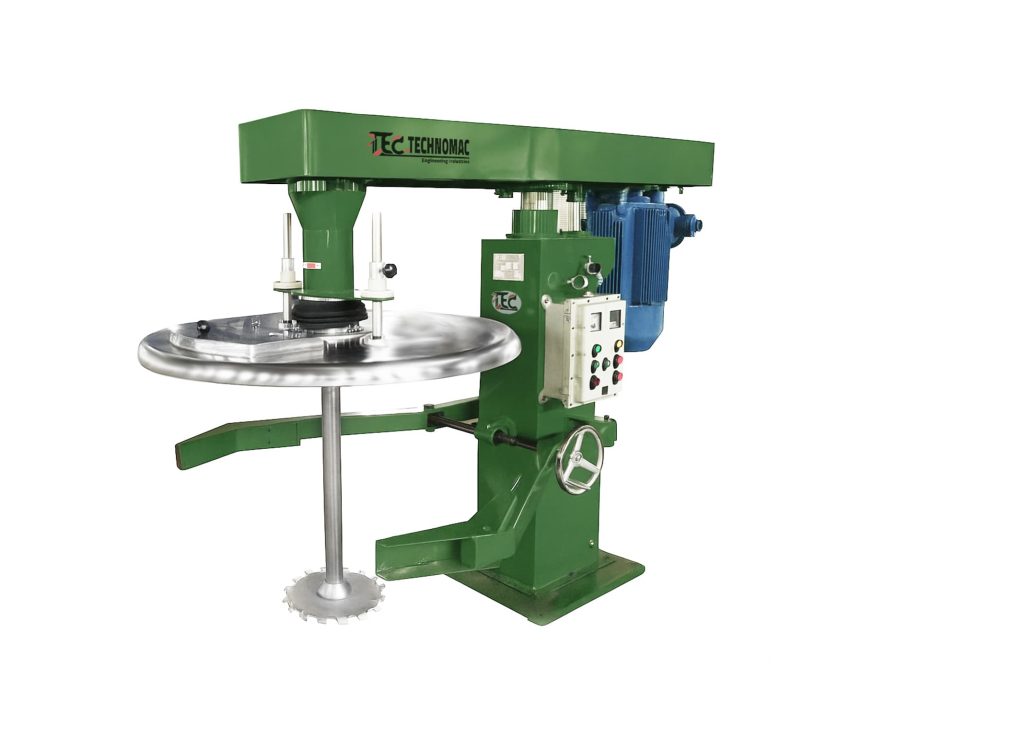
Industrial Dispersers and Agitators are fundamental machines for fluid mixing, particle size reduction, and homogeneous blending across countless processes. While often grouped, they serve distinct but complementary functions. An Agitator is designed for general mixing, blending, and maintaining uniformity of low to medium viscosity fluids. A Disperser (or High-Speed Disperser) is a more intensive machine engineered to de-agglomerate, wet, and disperse powdered solids into a liquid medium, creating a fine, stable emulsion or suspension. Together, they form the backbone of liquid processing operations, ensuring product consistency, quality, and efficiency.
Dispersion & Deagglomeration: Pigments into paints/coatings, fillers into adhesives, powders into cosmetics.
Solid-Liquid Mixing: Dissolving sugars/salts, suspending catalysts, preparing slurries.
Liquid-Liquid Blending: Creating stable emulsions for food, pharmaceuticals, and personal care.
Heat & Mass Transfer Enhancement: Improving reaction rates and uniform heating/cooling.
Paints, Coatings & Inks: For pigment grinding and base production.
Adhesives & Sealants: Incorporating fillers and additives.
Chemicals & Pharmaceuticals: Catalyst preparation, reactor mixing, synthesis.
Food & Beverage: Mixing sauces, dairy products, beverages, and ingredients.
Cosmetics & Personal Care: Manufacturing lotions, creams, and toothpastes.
Batteries & Advanced Materials: Electrode slurry preparation and nanocomposite dispersion.
Agitator: Utilizes a motor-driven shaft with impellers (e.g., propeller, turbine, paddle). The impeller rotation induces fluid flow, creating bulk motion for blending and maintaining homogeneity. It operates at lower tip speeds and applies moderate shear force.
Disperser: Features a high-horsepower motor driving a specially designed serrated or saw-tooth dispersion blade at very high tip speeds (typically 20-50 m/s). This creates intense hydraulic shear and micro-turbulence in the mixing vessel, rapidly breaking down agglomerates and achieving microscopic particle distribution.
Top-Entry Dispersers/Agitators: The most common type, mounted vertically on the top of a mixing tank. Ideal for open or closed vessels.
Portable Dispersers: Versatile, clamp-on units for smaller batches or R&D.
Fixed-Speed vs. Variable Frequency Drive (VFD): VFD control is standard for precision process control, allowing soft starts and adjustable speed for different phases (wetting vs. dispersing).
Hydraulic Lift & Dual-Motion Systems: Hydraulic systems allow the disperser head to be raised/lowered. Dual-motion systems combine dispersion with a rotating or planetary mixer for extremely high-viscosity materials.
⚙️ Technical Specifications & Features
" Core Technical Specifications "
| Parameter | Disperser (High-Speed) | Agitator (General Purpose) | |
|---|---|---|---|
|
1 |
Power Range |
5 kW to 250+ kW |
0.75 kW to 75 kW
|
|
2 |
Speed Range (VFD) |
500 – 3,000 RPM |
50 – 500 RPM
|
|
3
|
Tip Speed |
20 – 50 m/s |
3 – 15 m/s
|
|
4
|
Shaft Diameter |
40 – 150 mm (solid steel) |
25 – 100 mm |
|
5 |
Bearing Type |
Heavy-duty, double-row spherical roller |
Deep groove ball or taper roller
|
|
6
|
Lift Stroke (Hydraulic) |
Up to 2.5 meters |
Up to 1.5 meters (if equipped)
|
|
7 |
Sealing |
Mechanical seal or stuffing box, various grades |
Packing gland or standard mechanical seal |
|
8 |
Control Interface |
Local VFD panel with speed display; PLC integration optional |
Basic starter or VFD panel
|
" Advanced Technical Features "
Design & Operational Features
Heavy-Duty Construction: Rugged, reinforced shaft and blade assembly to withstand high torsional loads.
Precision-Ground Gears: For efficient power transmission and long service life in the gearbox.
Serrated Dispersion Blade: Optimized geometry (single or double row) for maximum shear and flow.
Modular Design: Interchangeable shafts, blades, and seals for different applications and easy maintenance.
Safety Features: Motor overload protection, emergency stop, mechanical shaft guards, and lock-out/tag-out points.
Key Advantages & Value Proposition
Process Efficiency: Drastically reduces mixing and dispersion cycles compared to simple stirring.
Superior Product Quality: Achieves consistent, repeatable fineness of grind and stable formulations.
Operational Flexibility: One machine can often handle multiple products via speed and blade adjustments.
Reduced Maintenance: Robust design and quality components minimize downtime and operational costs.
Scalability: Processes developed in the lab can be directly scaled to production using geometrically similar principles.
Installation & Considerations
Tank Design: Requires a properly baffled vessel to prevent vortexing and ensure optimal flow patterns.
Foundation/Vessel Support: Must account for significant dynamic loads and torque.
Utilities: Requires appropriate electrical supply (3-phase) and, for hydraulic lifts, a clean hydraulic power unit.
Process Integration: Can be integrated with automated material handling, temperature control (jacketed tanks), and vacuum/pressure systems.
