


Pressure Vessels
📝 Machine Overview
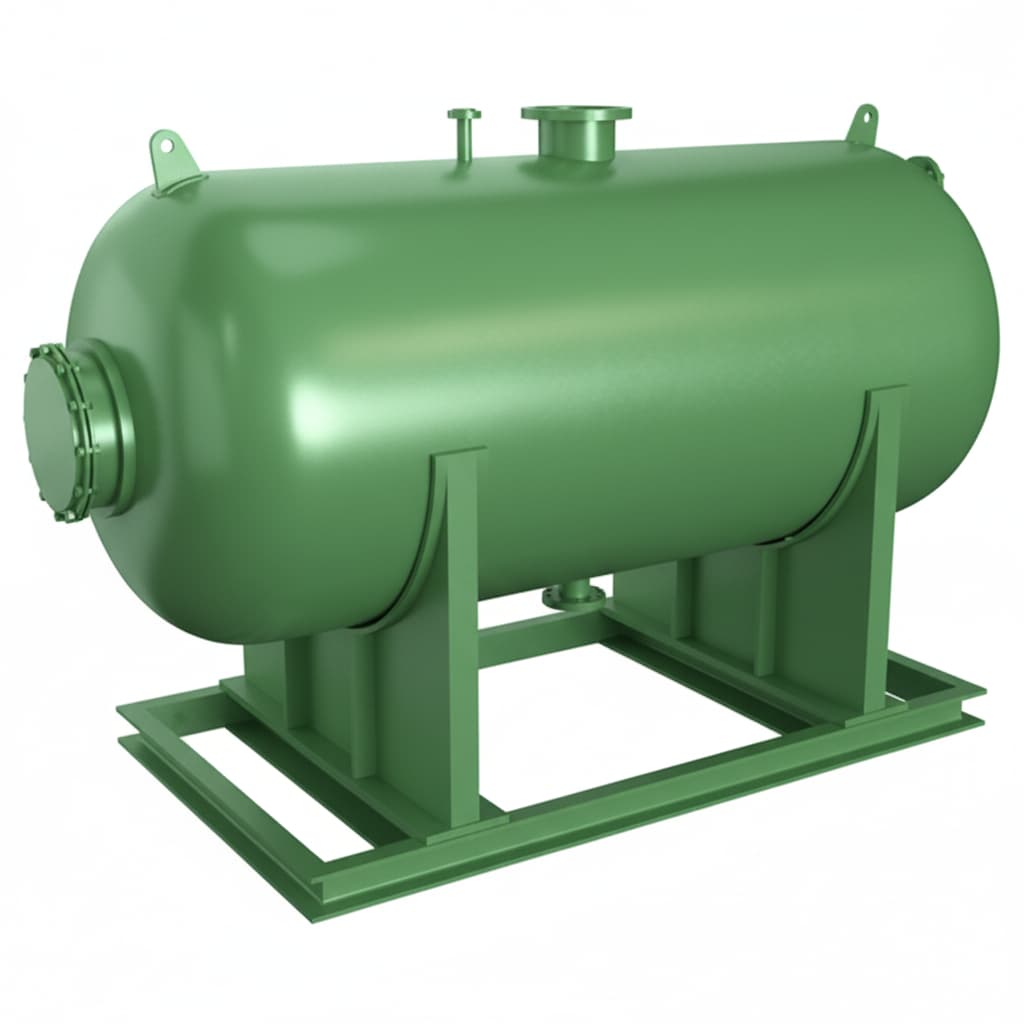
Pressure Vessels are engineered containment systems designed to operate safely at pressures significantly different from ambient atmospheric pressure, either internally or externally. As critical components in process and energy systems, they are not mere tanks but meticulously calculated and fabricated structures governed by stringent international safety codes. Our pressure vessels are designed, fabricated, and stamped in full compliance with the ASME Boiler and Pressure Vessel Code (BPVC) Section VIII, Division 1 or 2, ensuring the highest standards of safety, reliability, and performance for high-pressure and vacuum applications.
Chemical Processing: Catalytic reactors, autoclaves, high-pressure separators.
Oil & Gas: Production separators, scrubbers, amine contactors, bullet tanks.
Power Generation: Deaerators, feedwater heaters, steam accumulators.
Pharmaceutical: Supercritical fluid extraction (SFE) vessels, sterilization autoclaves.
Food & Beverage: Pressure retorts for sterilization, CIP/SIP vessels.
Industrial Gases: Storage and transportation of compressed and liquified gases.
Hydraulic Systems: Accumulators and pulsation dampeners.
Oil, Gas & Petrochemical
Chemical & Pharmaceutical
Power Generation (Fossil, Nuclear, Renewable)
Industrial Gases
Food & Beverage Processing
Pulp & Paper
Shipbuilding & Maritime
Aerospace & Defense
The primary function is to safely contain fluids (gases, liquids, or multi-phase mixtures) under elevated or reduced pressure. The design counteracts significant stress from internal pressure, external loads, and thermal gradients using optimized geometries (cylindrical, spherical heads) and advanced material selection. These vessels often serve as the core for unit operations where pressure is essential for reaction kinetics, separation efficiency, or energy storage.
By Design Code:
ASME Section VIII, Div. 1: Standard construction for common pressure ranges.
ASME Section VIII, Div. 2: Alternative rules for higher pressures, using more rigorous analysis, often resulting in thinner, lighter walls.
By Geometry & Orientation:
Horizontal Vessels: For liquid storage, phase separation (knockout drums), with saddle supports.
Vertical Vessels: For towers, reactors, scrubbers, with skirt or leg supports.
Spherical Vessels: For high-pressure gas storage (e.g., LPG, LNG), minimizing surface area-to-volume ratio.
By Primary Function:
Reactors: For chemical reactions under pressure (hydrogenation, polymerization).
Separators: Flash drums, distillation columns, coalescers.
Receivers: For compressed air, refrigerants, or process condensate.
Heat Exchangers (Shell & Tube): Where the shell side is a pressure-containing component.
Storage Vessels: For liquified gases (CO2, N2, O2) and volatile liquids.
⚙️ Technical Specifications & Features
" Core Technical Specifications "
| Parameter | Specification Range & Standards | |
|---|---|---|
|
1 |
Design Codes |
ASME BPVC Sec. VIII Div. 1 (U Stamp) or Div. 2 (U2 Stamp). Compliant with PED 2014/68/EU (CE Mark, H/PED Categories). |
|
2 |
Pressure Range |
High Vacuum (Full Vacuum) to 10,000+ psi (690+ bar), custom designs available. |
|
3
|
Temperature Range |
Cryogenic (-196°C / -320°F) to Elevated Temperatures (600°C+ / 1112°F+), material dependent. |
|
4
|
Capacity (Volume) |
50 Litres to 100,000+ Litres. |
|
5 |
Standard Materials |
Carbon Steel (SA-516 Gr. 70), Low-Temp Carbon Steel (SA-516 Gr. 60/65), Stainless Steels (SA-240 304/316L), Duplex/Super Duplex (SA-240 S31803/S32750), Nickel Alloys. |
|
6
|
Design Features |
Full penetration welds, post-weld heat treatment (PWHT) as required, hydrostatic/ pneumatic test per code. |
|
7 |
Corrosion Allowance |
Customized per process service life and fluid corrosivity. |
|
8 |
Nozzle & Manway Details |
Flanged (ANSI, DIN, EN) or butt-weld connections; full- or partial-bore manways per accessibility needs. |
|
9 |
Non-Destructive Examination (NDE) |
Mandatory RT (Radiography), UT (Ultrasonic), PT/MT (Liquid Penetrant/Magnetic Particle) per code and service requirements. |
" Advanced Technical Features "
Core Features & Fabrication Excellence
Code-Mandated Safety: Every vessel includes mandatory pressure relief devices (PRDs) sized and specified per ASME Sec. VIII and API RP 520/521.
Advanced Stress Analysis: Finite Element Analysis (FEA) for complex geometries, high-cycle fatigue applications, and non-standard load cases (seismic, wind).
Precision Fabrication: Computer-controlled cutting, rolling, and welding (SAW, GTAW, GMAW) with 100% traceability of materials (MTRs).
Comprehensive Heat Treatment: Stress Relieving (SR), Normalizing, or Solution Annealing performed in certified furnaces with full documentation.
Integrated Internals: Custom-designed trays, demister pads, vortex breakers, distributor pipes, and catalyst support grids fabricated to match vessel tolerances.
Complete Certification Package: Final vessel documentation includes Manufacturer’s Data Report (MDR), Design Calculations, NDE Reports, and Material Certifications.
Competitive Advantages
Uncompromising Regulatory Compliance: Our ASME U & U2 Stamp and ability to provide PED certification provide global market access and mitigate project risk.
In-House Engineering Authority: Licensed Professional Engineers (PE) and ASME-certified Design Engineers on staff for direct oversight, ensuring design integrity.
Lifecycle Cost Optimization: Div. 2 designs can reduce material costs and weight; robust fabrication extends service intervals, lowering total ownership cost.
Turnkey Customization: From a standard receiver to a complex, internals-packed process column, we manage the entire engineering and fabrication workflow.
Audit-Ready Documentation: We provide a complete, traceable, and impeccably organized data dossier for client audits and regulatory inspections.
Installation, Inspection, & Maintenance
We provide detailed installation manuals, including lifting lugs and rigging plans. All vessels undergo a mandatory Hydrostatic Test at 1.5x MAWP (or per code) witnessed and signed off by an authorized Inspector. We offer field service for periodic in-service inspections (ISI) as per API 510 or national regulations, ensuring continued safe operation.
