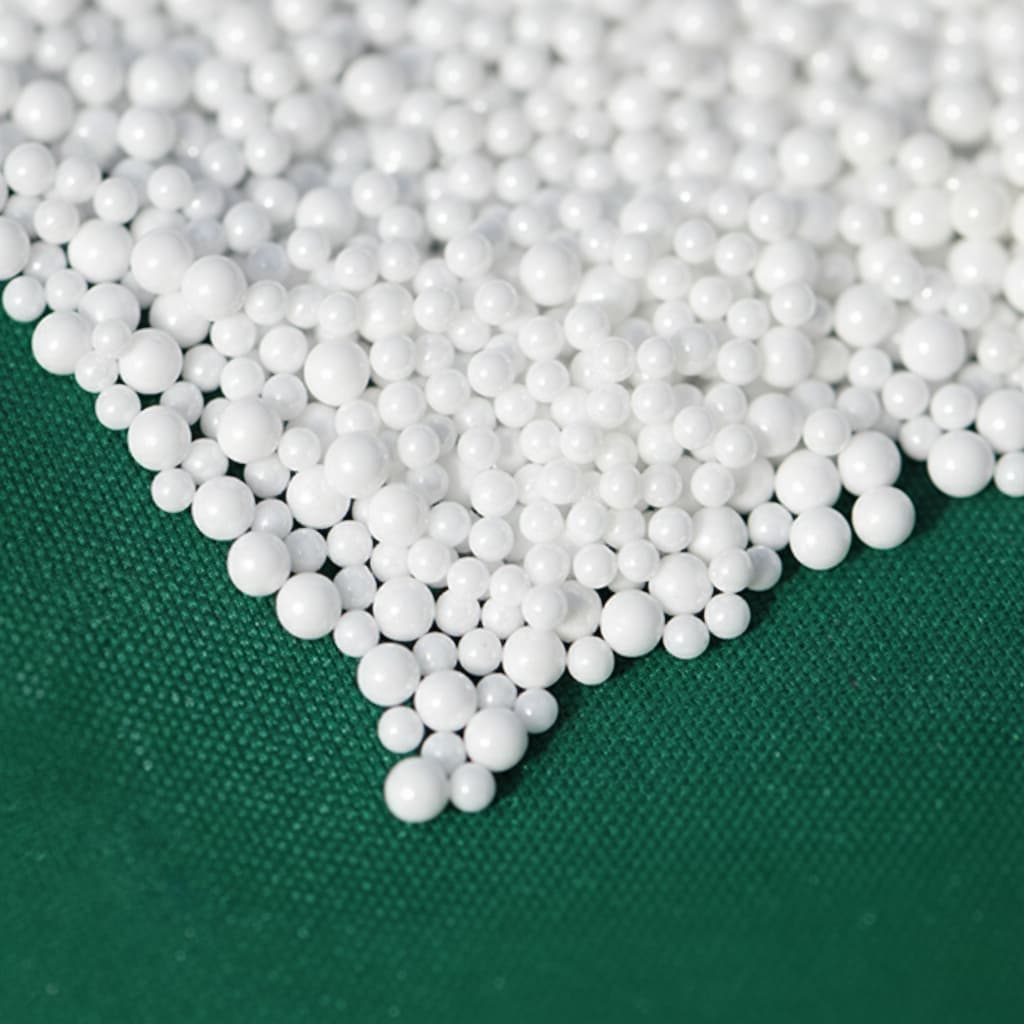
Zirconia Ceramic Microbeads

📝 Machine Overview
Zirconia Ceramic Microbeads are high-performance, engineered grinding and dispersion media designed for ultra-fine particle size reduction and homogeneous mixing in agitated bead mills. Unlike a standalone machine, these microbeads are a critical consumable component that directly determines the efficiency, final product quality, and operational cost of wet milling and dispersion processes. Our yttria-stabilized zirconia (YSZ) beads offer an unparalleled combination of density, hardness, and wear resistance, making them the premium choice for demanding applications.
Ultra-Fine Grinding: Of minerals, ceramics, and inorganic pigments.
High-Quality Dispersion: Of organic pigments, dyes, carbon black, and TiO₂ in paints, inks, and coatings.
Nanomaterial Production: For creating stable nano-suspensions in electronics and advanced materials.
Pharmaceutical Milling: Wet milling of active pharmaceutical ingredients (APIs) to micron and sub-micron levels.
Agrochemical Formulation: Grinding and dispersion of pesticides and herbicides for improved efficacy.
Digital Inkjet Inks: Achieving the flawless dispersion required for high-performance print heads.
Paints, Coatings & Inks
Chemicals & Pigments
Pharmaceuticals & Biotechnology
Electronics & Ceramics
Agrochemicals
Mining & Minerals (ultra-fine grinding)
Research & Development
In a bead mill (e.g., horizontal or vertical), these microbeads are loaded into a grinding chamber along with the process slurry. As the agitator rotates at high speed, it imparts kinetic energy to the beads, creating intense shear and impact forces. The beads collide with each other and the particles in the slurry, resulting in comminution (size reduction), de-agglomeration, and dispersion. The higher the density and sphericity of the beads, the more energy is transferred, leading to faster grinding and finer particle sizes.
Yttria-Stabilized Zirconia (YSZ): Standard grade offering the best balance of properties for most applications.
Ceria-Stabilized Zirconia (CeSZ): Enhanced toughness for specific high-impact applications.
Zirconium Silicate (ZrSiO4): A cost-effective alternative for less demanding dispersions where iron contamination is a concern.
Surface-Treated Beads: Special coatings or surface finishes to reduce bead agglomeration or specific adhesion.
⚙️ Technical Specifications & Features
" Core Technical Specifications "
| Parameter | Typical Specification | |
|---|---|---|
|
1 |
Material Composition |
>95% ZrO₂, stabilized with 3-5 mol% Y₂O₃ (Yttria). |
|
2 |
Bead Diameter Range |
0.1 mm (100µm) to 3.0 mm (standard), custom sizes available. |
|
3
|
True Density |
~6.0 g/cm³ (provides high kinetic energy). |
|
4
|
Bulk Density |
~3.7 g/cm³ (for loading calculations). |
|
5 |
Mohs Hardness |
≥9.0 |
|
6
|
Compressive Strength |
>2,000 MPa |
|
7 |
Shape & Sphericity |
>95% perfect spheres (ensures uniform grinding and reduces wear). |
|
8 |
Color |
White, polished surface. |
|
9 |
Chemical Inertness |
Highly inert, suitable for acidic and alkaline slurries. |
" Advanced Technical Features "
Core Features
Exceptional Wear Resistance: The highest among oxide ceramic media, resulting in minimal bead attrition, lower product contamination, and extended service life.
High Density & Hardness: Delivers superior impact energy for faster grinding cycles, higher throughput, and the ability to achieve nanometer-scale fineness.
Perfect Sphericity & Narrow Size Distribution: Ensures consistent grinding action, prevents clogging in separator systems, and minimizes pressure build-up in the mill.
Polished, Non-Porous Surface: Minimizes product adhesion and facilitates easy cleaning, reducing cross-contamination between batches.
Chemically Inert: Does not react with most process materials, ensuring product purity and stability.
Zero Metallic Contamination: Essential for high-purity industries like electronics and pharmaceuticals, where even trace metals are unacceptable.
Competitive Advantages
Lower Total Cost of Operation (TCO): While the initial investment is higher, vastly extended lifespan and reduced product contamination lead to significant long-term savings over glass, steel, or other ceramic beads.
Unmatched Process Efficiency: Achieves target fineness faster, reducing milling time and energy consumption per batch.
Superior End-Product Quality: Enables finer particle sizes, narrower PSD, and more stable dispersions, enhancing the color strength, gloss, and performance of final products.
Process Consistency: Uniform bead properties ensure reproducible results from batch to batch, crucial for quality control.
Technical Partnership: We provide not just beads, but application support for bead size selection, mill loading recommendations, and process optimization to maximize your ROI.
Selection & Usage Guidelines
Selecting the correct bead size is critical: smaller beads (0.1-0.6mm) for sub-micron/nano grinding; medium beads (0.7-1.5mm) for general fine grinding; larger beads (1.5-3.0mm) for pre-grinding or viscous products. Optimal bead load is typically 70-85% of the grinding chamber volume. Always consult with our engineers to match the bead specification to your mill type, rotor speed, and product characteristics.