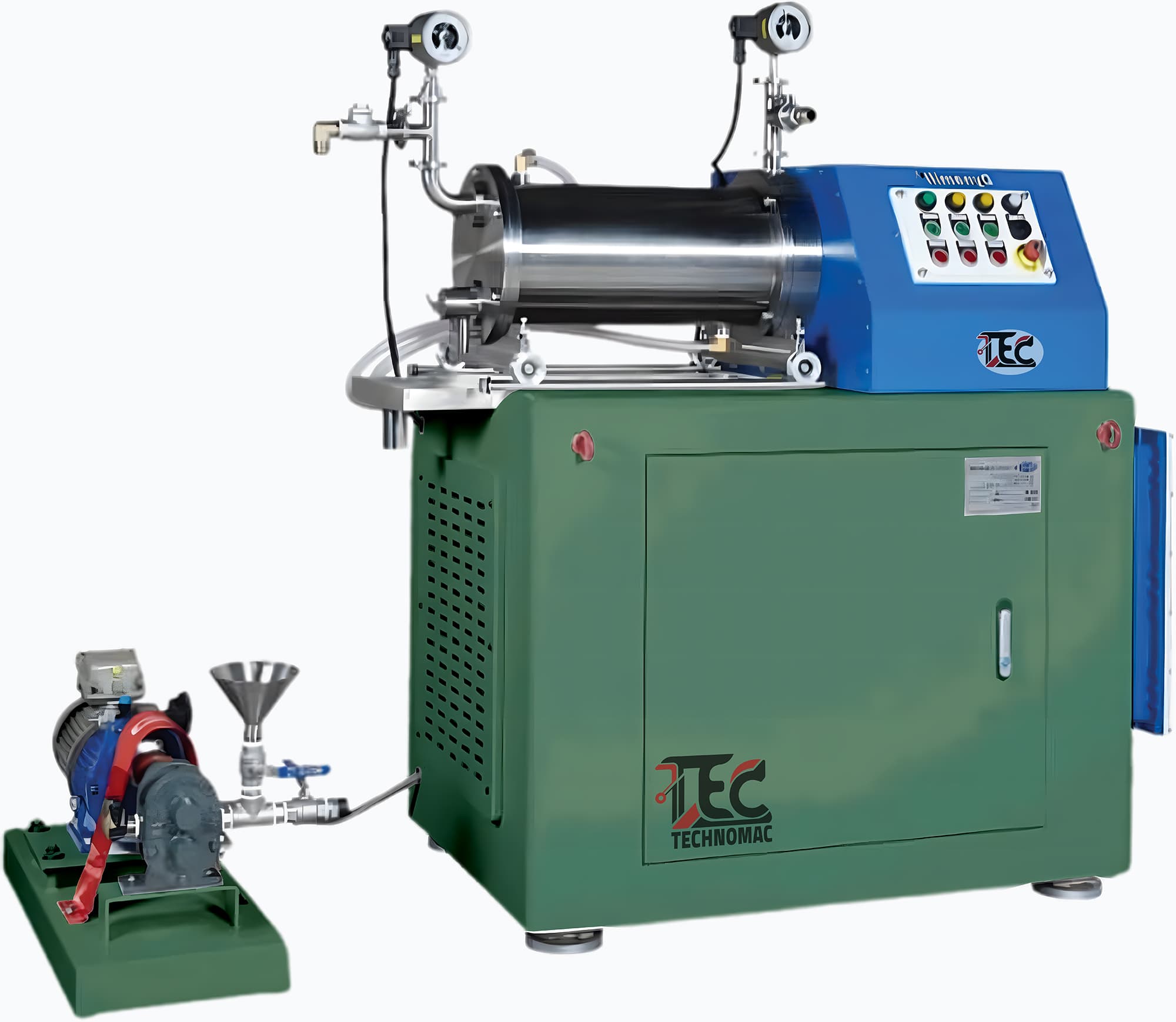
Sand Mills

📝 Machine Overview
Industrial Sand Mills, more accurately termed Bead Mills, are the workhorse of particle size reduction and dispersion technology. Designed for wet grinding and fine dispersion of solid particles within a liquid vehicle, they achieve micron and sub-micron fineness essential for product performance and stability. By leveraging a high-density grinding media (beads) agitated within a sealed chamber, sand mills apply intense mechanical shear to break down agglomerates and primary particles. They are the critical link between raw ingredients and a flawless, stable, and high-performance final product across countless industries.
Paints & Coatings: Production of automotive OEM/refinish, industrial, and decorative paints, achieving optimal color strength and gloss.
Inks: Grinding of pigment dispersions for printing inks (flexographic, gravure, UV-curable).
Agrochemicals: Manufacturing of suspension concentrates (SC) and capsule suspensions (CS) for stable pesticide formulations.
Battery Slurries: Fine grinding and dispersion of active materials for Lithium-ion battery electrodes.
Digital Pigments: Preparation of nano-dispersions for inkjet and toner applications.
Pharmaceuticals: Size reduction in APIs (Active Pharmaceutical Ingredients) and creation of fine suspensions.
Ceramics & Pigments: Processing of ceramic frits and high-performance pigment pastes.
Coatings & Paint Manufacturing
Printing & Packaging
Chemical & Agrochemical Production
Renewable Energy (Battery Manufacturing)
Electronics & Pigment Technology
Pharmaceuticals
Ceramics & Advanced Materials
The process is based on a continuous or batch recirculation system. A pre-mixed slurry (the “millbase”) is pumped into a grinding chamber filled to a specific volume with small, dense grinding beads (typically made of glass, zirconia, or ceramic). A high-speed rotor (disc, pin, or shaft design) agitates the beads, creating intense kinetic energy and shear forces in the narrow gaps between them. As the slurry passes through this dynamic bead matrix, particles are subjected to impact and attrition, resulting in precise size reduction and homogeneous dispersion. The mill’s separator (screen, cartridge, or dynamic gap) retains the beads while allowing the processed product to exit.
Horizontal Sand Mills: The most common industrial type, offering high energy density, efficient cooling, and easy maintenance. Ideal for medium to high-viscosity products.
Vertical Sand Mills: Often used for lower viscosity products and applications where floor space is a constraint.
Basket Mills: An immersion-type batch mill where the agitator and beads are contained in a submerged basket. Excellent for quick color changes and small batches.
Circulation Mill Systems: A closed-loop configuration where the millbase is repeatedly passed through a smaller mill chamber for ultra-fine grinding and tight particle size distribution control.
⚙️ Technical Specifications & Features
" Core Technical Specifications "
| Parameter | Illustrative Model: SMH-100L Horizontal Sand Mill | |
|---|---|---|
|
1 |
Chamber Volume |
5 kW to 250+ kW |
|
2 |
Rotor System |
500 – 3,000 RPM |
|
3
|
Grinding Chamber |
20 – 50 m/s |
|
4
|
Bead Separation System |
40 – 150 mm (solid steel) |
|
5 |
Grinding Media |
Heavy-duty, double-row spherical roller |
|
6
|
Drive Power |
Up to 2.5 meters |
|
7 |
Construction Materials |
Mechanical seal or stuffing box, various grades |
|
8 |
Control System |
Local VFD panel with speed display; PLC integration optional |
|
9 |
Capacity |
Throughput variable; typically 200-800 L/hr depending on material and fineness target. |
" Advanced Technical Features "
Core Features
Advanced Separation Technology: Guaranteed bead retention with zero-blockage separators (screenless dynamic or slit-gap systems), ensuring process integrity and no product contamination.
Optimized Cooling Design: Large-surface jacketed chamber and often cooled rotor shaft prevent thermal degradation of heat-sensitive products.
Wear-Resistant Construction: Interchangeable liners and rotors made from advanced materials (e.g., tungsten carbide) for extended service life with abrasive products.
Scalable Geometry: Chamber and rotor designs maintain consistent shear and energy input from laboratory to production scale, ensuring reproducible results.
High Energy Density: Efficient transfer of motor power to the grinding zone for faster processing and finer particle size attainment.
Competitive Advantages
Superior Fineness & Narrow PSD: Achieves consistent, repeatable particle sizes in the low-micron and nanometer range with a tight Particle Size Distribution (PSD), enhancing product color, stability, and performance.
High Operational Efficiency: Continuous processing capability leads to higher throughput and lower energy consumption per liter compared to many batch dispersion methods.
Process Control & Consistency: Integrated monitoring of key parameters (power draw, temperature, flow) allows for precise endpoint determination and unmatched batch-to-batch consistency.
Reduced Contamination Risk: Enclosed system minimizes solvent evaporation, dust, and operator exposure, while wear-resistant materials prevent product metal contamination.
Versatility: Capable of handling a vast range of viscosities and formulations, from low-viscosity inks to high-solid-content paste-like materials.
Installation & Operational Considerations
Requires a stable foundation, connection to electrical power, cooling water supply, and compatibility with feed and discharge pumping systems. Operational success heavily depends on the correct selection of grinding media size and type, chamber cooling efficiency, and millbase formulation. We provide comprehensive commissioning, grinding media selection guidance, and process optimization support.
Conclusion
Our Sand Mills are engineered for demanding production environments where final product quality is defined by dispersion fineness and stability. They offer a robust, efficient, and controllable solution for achieving superior dispersion quality at scale. Contact our technical team to discuss your specific particle size reduction challenges and explore a configuration designed for your productivity and quality goals