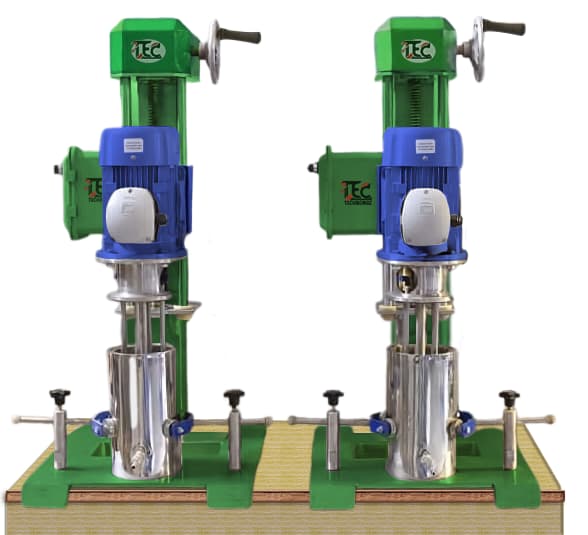
Lab Mixers
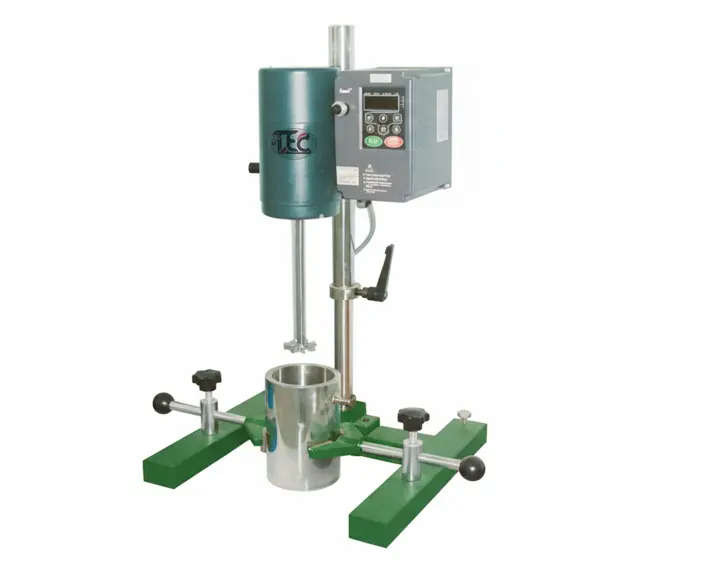
📝 Machine Overview
Laboratory Mixers are precision-engineered benchtop and floor-standing units designed for the development, formulation, and small-scale production of liquid, semi-solid, and powder mixtures in R&D, QC, and pilot plant environments. These versatile instruments provide critical data on mixing behavior, dispersion quality, and process parameters, enabling reliable scale-up to full production. Our range of lab mixers offers controlled shear, variable speed, and a variety of mixing geometries to replicate production conditions at a fraction of the volume, ensuring accurate formulation development and problem-solving.
Formulation Development: Creating and optimizing new products in paints, coatings, adhesives, cosmetics, and food.
Raw Material Evaluation: Testing the dispersibility and performance of new pigments, fillers, or active ingredients.
Process Simulation & Scale-Up: Determining optimal agitation speed, time, and energy input for production-scale equipment.
Quality Control & Batch Testing: Reproducing production mixing parameters to verify batch consistency and troubleshoot quality issues.
Sample Preparation: Preparing homogeneous samples for analytical testing (pH, viscosity, particle size analysis).
Paints, Coatings & Inks R&D
Adhesives & Sealants Formulation
Cosmetics & Personal Care Development
Pharmaceutical & Biotechnology R&D
Food Science & Ingredient Development
Advanced Materials & Composites
Academic & Government Research Labs
Lab mixers operate on the same fundamental principles as industrial mixers, using a rotating impeller or rotor-stator assembly to impart kinetic energy to the fluid. The key is achieving geometric and dynamic similarity—maintaining consistent shear rate, power per volume (PV), or tip speed between the lab batch and the full-scale production batch. This allows for the accurate prediction of mixing times, dispersion quality, and energy requirements, de-risking the scale-up process.
Overhead Stirrers (Digital/Mechanical): Versatile, with a wide range of interchangeable shafts and impellers (propeller, paddle, anchor) for gentle to medium-shear blending and dissolution.
High-Shear Rotor-Stator Mixers (Inline & Batch): For intense dispersion, emulsification, and particle size reduction. The rotor turning within a close-clearance stator creates intense shear and cavitation.
Planetary Centrifugal Mixers: For high-viscosity pastes, adhesives, and battery slurries. Blades rotate on their own axis while orbiting the mix vessel, ensuring complete homogenization without entrapping air.
Dual-Shaft Mixers: Combine a low-speed anchor sweep with a high-speed disperser blade in one head, ideal for complex multi-stage mixing processes (powder incorporation followed by high-shear dispersion).
Magnetic Stirrers & Hotplates: For simple, low-viscosity stirring and heating applications.
⚙️ Technical Specifications & Features
" Core Technical Specifications "
| Parameter | Specification Range | |
|---|---|---|
|
1 |
Drive Type |
Digital, brushless DC motor or AC geared motor.
|
|
2 |
Speed Range |
10 to 3,000+ RPM (overhead); 500 to 20,000+ RPM (rotor-stator).
|
|
3
|
Torque Output |
0.1 Nm to 50+ Nm (for high-viscosity applications).
|
|
4
|
Power Rating |
30W to 2,000W.
|
|
5 |
Speed Control |
Digital feedback control with constant torque mode to maintain speed under load.
|
|
6
|
Display & Readout |
Digital RPM, torque (% or Nm), power (W), and optional USB data logging.
|
|
7 |
Mixing Vessel Compatibility |
Standard laboratory glassware (beakers, flasks) to custom 1-20 liter process vessels.
|
|
8 |
Impeller/Shaft Options |
Propeller, 3-Blade Pitch, Turbine, Anchor, Cowles Disc, Interchangeable rotor-stator generators (fine, coarse, slotted).
|
|
9 |
Material of Construction |
Stainless steel 316L shafts, PTFE or chemically resistant coated motors for fume hood use.
|
|
10 |
Lifting Mechanism |
Manual or motorized vertical lift for easy shaft immersion and vessel positioning.
|
|
11 |
Safety Features |
Overload protection, automatic shut-off, splash guard, stable heavy-duty base.
|
" Advanced Technical Features "
Core Features
Precision Speed & Torque Control: Digital closed-loop control maintains set speed even as viscosity changes, and displays torque as a direct indicator of process load and mixture rheology.
Modular & Versatile Design: A single drive unit capable of accepting multiple agitator shafts and mixing heads (overhead, rotor-stator, dual-shaft) maximizes flexibility for diverse lab applications.
Scalable Data Acquisition: Integrated sensors and data logging capabilities (via USB or software) allow recording of RPM, torque, temperature, and energy input (kWh/kg) for direct scale-up calculations.
Hygienic & Easy-Clean Design: Sealed drive shafts, polished stainless steel components, and smooth surfaces facilitate cleaning and prevent cross-contamination between batches.
Process-Ready Accessories: Compatible with jacketed vessels for temperature control, vacuum lids for deaeration, and bottom- discharge valves for sample extraction.
Robust & Reliable Construction: Designed for daily use in demanding lab environments, with durable motors and precision bearings for consistent, repeatable performance.
Competitive Advantages
De-Risked Scale-Up: Provides accurate, quantitative process data (tip speed, PV, mixing time) that enables confident and efficient translation from lab to production, saving time and costly production trials.
Enhanced R&D Productivity: One versatile system can handle a wide array of mixing tasks, from gentle stirring to high-shear dispersion, streamlining the formulation workflow.
Improved Formulation Quality: Precise control over shear and mixing energy leads to more consistent, reproducible results, accelerating development cycles.
Reduced Material Waste: Small batch sizes (as low as 50ml with appropriate accessories) allow for extensive experimentation with minimal consumption of expensive raw materials.
Technical Application Support: We provide more than equipment; we offer application guidance to select the right tool and parameters for your specific mixing challenge.
Selection & Operational Considerations
Selecting the correct lab mixer requires analysis of the material’s viscosity, desired outcome (blending, dissolving, dispersing, emulsifying), and the required sample volume. Proper shaft alignment, immersion depth, and off-center positioning (to prevent vortexing) are critical for effective mixing. We provide application support to ensure the selected configuration meets your research objectives.