'/%3E%3C/svg%3E)
'/%3E%3Cpath%20d='m454%20250-4%204-4-4c-3%203-9%205-9%205l2-5q-9%205-10%203c-1-1%2010-12%2012-26%200-1%203-18-8-13-2%201-4-5%200-7%203-2%2010-1%2011%200q1-2%203-2c2%200%2011%201%2014%206%202%205%202%2014%202%2015q0%2015%208%2027c-1%201-8-2-8-2v3s-7-2-9-4m-12-32c4%2014-9%2031-11%2033%2011%200%2012-10%2015-24l1%201c-2%2011-5%2022-8%2025l7-4%203-22h1l-3%2022%203%203%203-3-1-21h1l1%2021%208%203c-5-8-6-25-6-23h1c2%2012%203%2022%2012%2022-3-3-8-16-7-25q0-12-2-15-6-3-10%202-2%202-5-1c-2-2-1-2-6-4q-7-2-6%205s9-3%2013%205zm7-8q-3%201-1%202%203%200%201-2'/%3E%3C/g%3E%3C/svg%3E)

Written by: Technomac Experts | October 15, 2025
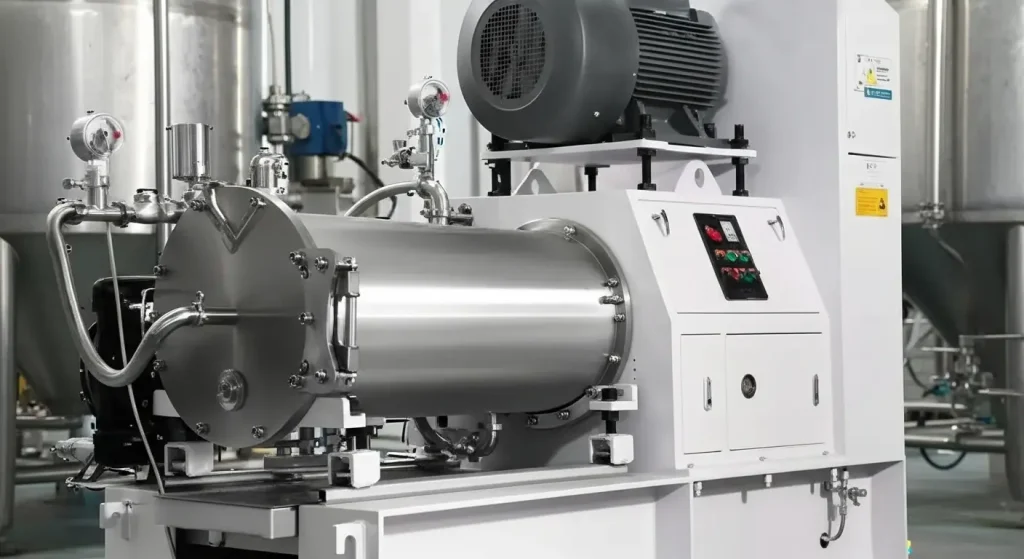
Introduction
Sand (bead) milling is a cornerstone unit operation for modern agrochemical formulators — especially mid-size companies producing suspension concentrates (SC), wettable powders (WP slurry stages), and certain emulsifiable concentrates (EC) where fine dispersion and particle stability determine product performance. This article examines, with technical depth, how sand mills deliver practical solutions for such manufacturers: the grinding and dispersion mechanisms, process variables, material choices, scale-up considerations, product quality outcomes, and operational best practices.
Why sand milling matters in agrochemical formulation
Active ingredients in many pesticide and fertilizer products are insoluble solids or poorly soluble liquids that must be distributed as fine, stable particles within a liquid carrier. Particle size and size distribution directly affect:
Efficacy — smaller, consistent particles increase active surface area and bioavailability.
Stability — reduced tendency for sedimentation or agglomeration.
Sprayability — nozzle performance and clogging risk.
Safety and handling — predictable rheology and reduced dusting.
Sand mills perform high-energy wet grinding and dispersion to reduce agglomerates and produce narrow particle size distributions (PSD) that meet these targets.
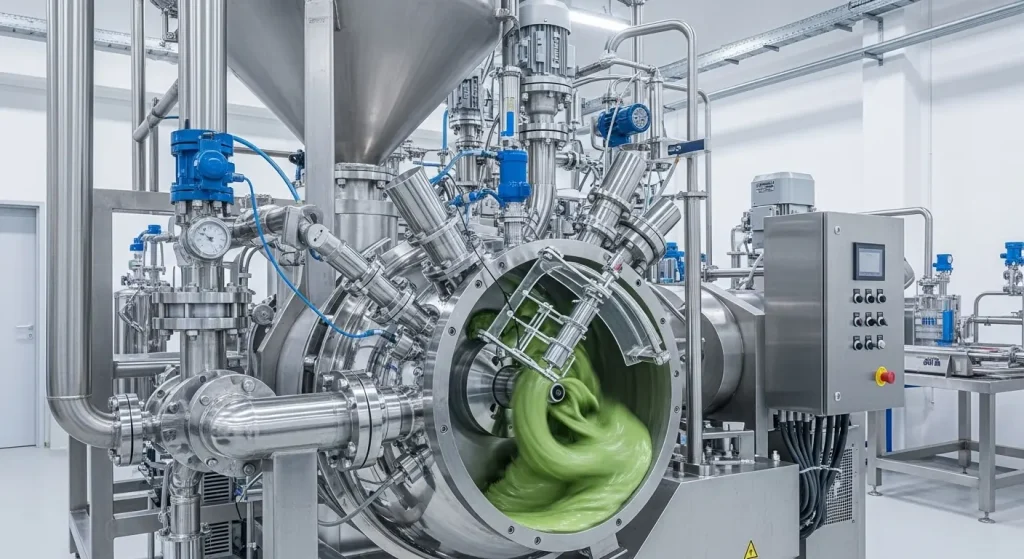
Core mechanisms: impact, shear, and attrition
Bead mills use a densely packed bed of grinding media (beads) in a stirred chamber. Particle size reduction occurs through a combination of:
Impact — beads collide with particles and each other, fracturing agglomerates.
Shear — viscous forces between beads and the slurry shear apart weakly bound clusters.
Attrition — abrasion between particles and bead surfaces wears down particles over many contacts.
Understanding which mechanism dominates helps select bead size, bead material, and mill configuration.
Key process variables and their effects
Bead size and material
Smaller beads (0.1–0.5 mm) give finer PSD and higher specific surface but require higher energy and generate heat.
Larger beads (0.8–2.5 mm) are effective for coarse deagglomeration and high throughput.
Typical bead materials: zirconia (ZrO₂) for top performance (low contamination, high density), glass for low cost (but higher breakage risk), stainless steel rarely used with corrosive chemistries.
For agrochemicals, yttria-stabilized zirconia beads are a common choice to minimize contamination and wear.
Energy input and milling time (specific energy)
Particle size correlates with cumulative specific energy (kWh/kg). Engineers target an energy budget to reach the D50 or D90 spec required by formulation testing.
Over-milling can increase surface energy and re-agglomeration risk; under-milling leaves coarse tails that harm performance.
Solids concentration and viscosity
Higher solids allow throughput efficiency but increase viscosity and reduce bead mobility, requiring adjustments in agitation or bead size.
Typical SC slurries operate in a solids range optimized for the active ingredient and dispersant package.
Temperature control
Milling generates heat; sensitive actives and dispersants degrade above certain temperatures. Effective cooling jackets or external heat exchangers maintain thermal stability and avoid quality loss.
Dispersant and surfactant chemistry
The right dispersant reduces interparticle attraction (lower zeta potential or steric hindrance) and stabilizes the milled suspension. Surface chemistry must be optimized together with PSD targets.

Materials of construction and corrosion considerations
Agrochemical environments are often corrosive or solvent-rich. Mill wetted parts must be chosen accordingly:
316L stainless steel is common for moderate chemistries.
For highly corrosive media or long contact times, duplex stainless steels or coated interiors are preferable.
Seals, gaskets and internal linings should use PTFE, PEEK, or UHMWPE where chemical resistance is required.
Selecting appropriate materials reduces contamination risk and extends mean time between maintenance.
Scale-up and production integration
Moving from lab/pilot bead mills to production scales requires attention to:
Geometric similarity vs dynamic similarity — specific energy per mass and bead collision frequency, not just mill size, determines PSD.
Residence time distribution — continuous bead mills offer steady operation but must be tuned to avoid short-circuiting.
Bypass rates and recirculation loops — allow staged processing to hit PSD targets without excessive energy use.
Inline particle size measurement (laser diffraction, acoustic sensors) for real-time control and endpoint detection.
A structured scale-up protocol: lab screening → pilot verification at representative specific energy → limited trial production → full-scale commissioning minimizes risk.
Quality control, safety and environmental aspects
QC metrics: D10/D50/D90, viscosity, zeta potential, sedimentation index, and assay of active ingredient.
Containment: closed recirculation systems and dust control for powders reduce operator exposure.
CIP capability: clean-in-place designs minimize downtime between batches and prevent cross-contamination.
Waste handling: used beads, spent solvent and rinse streams require compliant disposal or recycling strategies.
Explosion and fire safety: solvent-based formulations mandate ATEX/NEC compliance and appropriate grounding/ventilation.
Operational best practices and ROI considerations
Perform media life studies to balance bead cost against milling performance.
Implement preventive maintenance for agitators, seals and pumps—these are common failure points.
Optimize milling schedules to match production windows and heat loads.
Energy efficiency and reduced downtime translate directly into ROI: fewer rejects, longer equipment life, and improved product consistency.
Conclusion
For mid-size agrochemical formulators, bead mills are not mere grinders — they are precision process units that transform product performance, extend shelf life, and enable reliable, scalable production. Correct selection of bead type and size, materials of construction, thermal management, and integrated process control are the levers that turn a good formulation into a commercially robust product. With disciplined scale-up, robust QC, and engineered plant integration, sand mills provide a measurable competitive advantage in the demanding world of fertilizer and pesticide manufacturing.
Ready to build your production line?
Our experts design and build custom industrial machines tailored to your needs.